The Mond Crucifixion
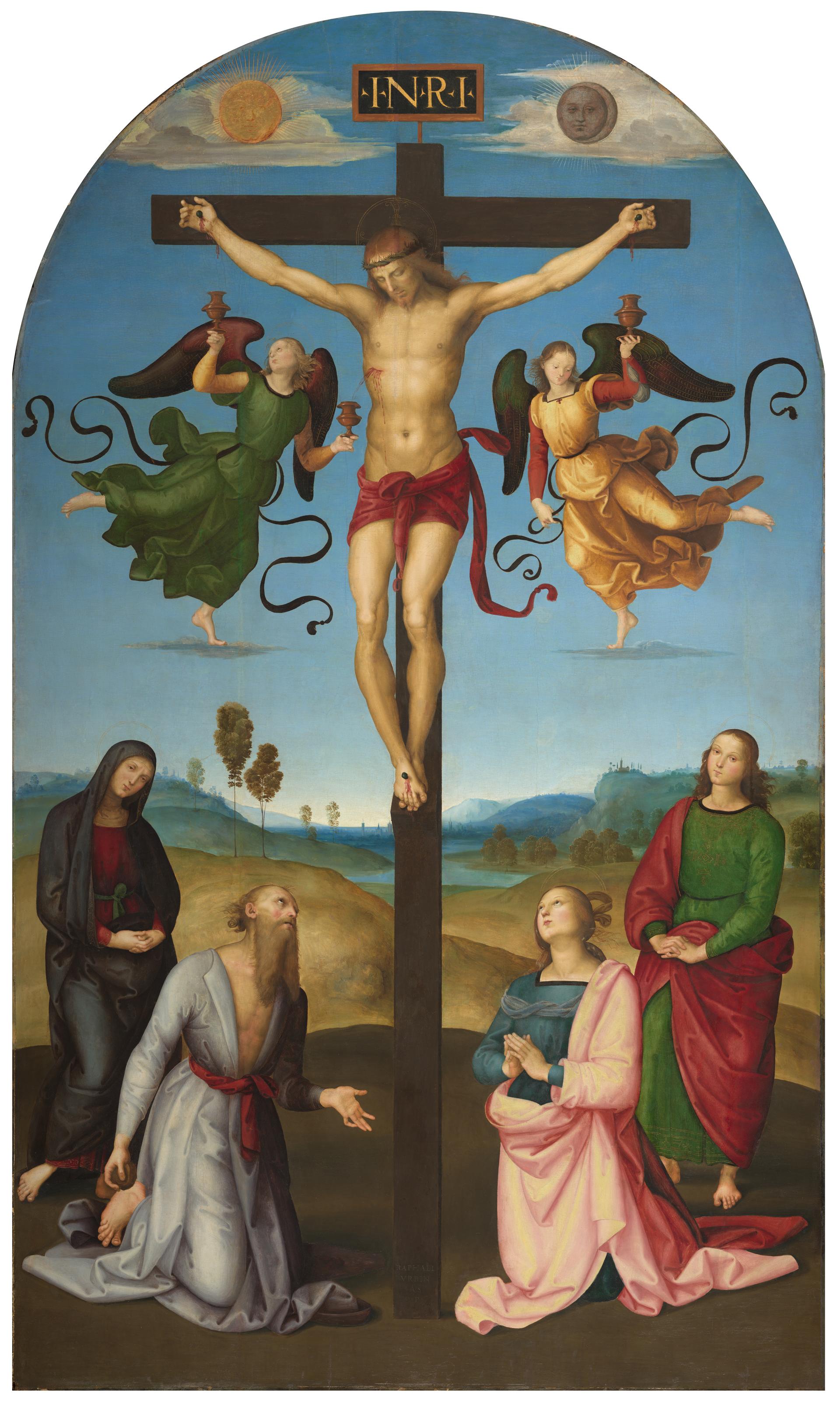
- Artist: Raphael
- Date: about 1502-3
- Medium: oil on wood
- Museum: The National Gallery
- Collection record: The National Gallery website
Listen to the free audio guide
About this artwork
This is the "Mond Crucifixion" painted by Raphael around 1502-3. The painting is an altarpiece, meaning it was originally placed at the front of a church altar. It's a work from Raphael's early career, and this particular piece shows his debt to the artist Perugino, who was leading the artistic movement in central Italy at the time.
The composition is based on several versions of the crucified Christ in a landscape painted by Perugino. You can see similarities with one of Perugino's altarpieces from 1502, which Raphael would have likely seen while living and working in Perugia.
In the painting, Christ's body hangs from the Cross, surrounded by two angels who are catching his blood in golden chalices. The Virgin Mary and John the Evangelist stand at the foot of the Cross, looking towards us with hands clasped together in grief. Saint Jerome is included because this chapel was dedicated to him.
The painting shows a strong sense of symmetry and harmony, which were key principles for Perugino's compositions. Raphael adapted these principles, giving them greater softness and sophistication. He also used some of Perugino's techniques, such as dark hatched brushstrokes to reinforce areas of shadow, but made the composition his own.
Raphael even left us a clue about his creative process - you can see his fingerprints and palm prints in the shadows of the heads, especially in Christ's hair, face, and beard. And if you look closely at the bottom right corner of the painting, you'll see Raphael's signature scratched into the paint.
See it in person
The Mond Crucifixion hangs in The National Gallery on Trafalgar Square, London — free to enter. Point your phone at any artwork there and audioguide.london plays a free audio guide in six languages — no app download needed.