The Ambassadors
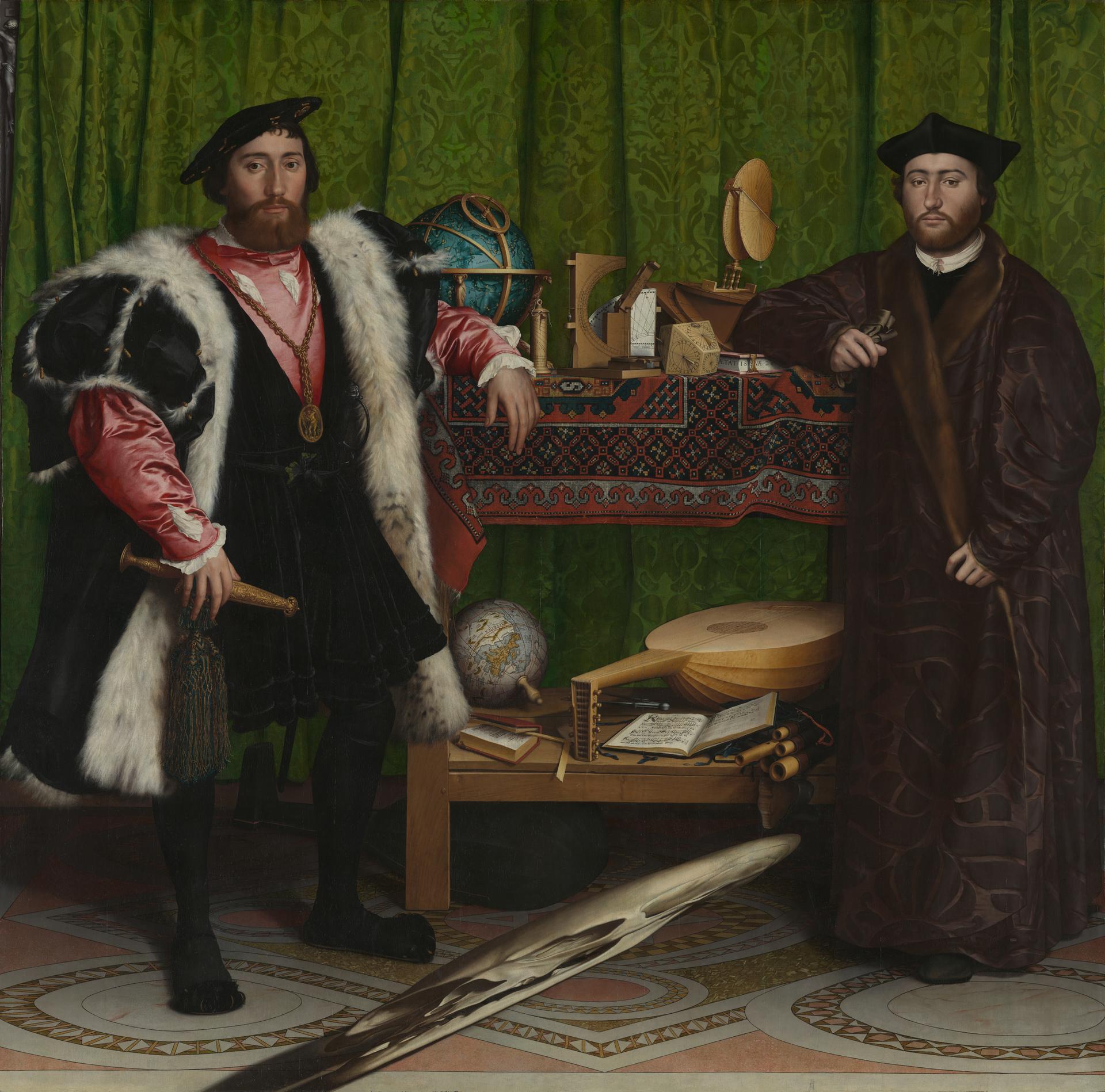
- Artist: Hans Holbein the Younger
- Date: 1533
- Medium: oil on wood
- Museum: The National Gallery
- Collection record: The National Gallery website
Listen to the free audio guide
About this artwork
This is "The Ambassadors" by Hans Holbein the Younger. Painted in 1533, it's a portrait of two men: Jean de Dinteville, the French ambassador to England, and Georges de Selve, Bishop of Lavaur. The painting showcases the wealth and status of its sitters at a time of great religious upheaval in Europe.
Notice how the objects on the table seem to allude to the complexities of the political climate. There's an arithmetic book open to a page about mathematical division, suggesting that Henry VIII's marriage to Anne Boleyn may have been a bit contentious. The presence of musical instruments and a celestial globe also highlights the men's understanding of mathematics and science.
Take a closer look at Dinteville's pink satin tunic - it's painted with incredible detail, almost as if you could feel its smoothness. And those gold tassels on his scabbard? They were created using Holbein's usual gilding technique, involving layers of oil mordant and gold leaf.
But what really sets this painting apart is its use of anamorphosis - the distorted, elongated shape between Dinteville's feet is actually a large skull. It can only be seen properly from a certain angle, adding to the sense of mystery and depth in the painting. Equally hidden at the top left is a crucifix, hinting at the hope of redemption in Christ.
See it in person
The Ambassadors hangs in The National Gallery on Trafalgar Square, London — free to enter. Point your phone at any artwork there and audioguide.london plays a free audio guide in six languages — no app download needed.